




What will Warsh do?
A look at the equity market’s historical response to new Fed Chairs.
Published: 05/26/2026
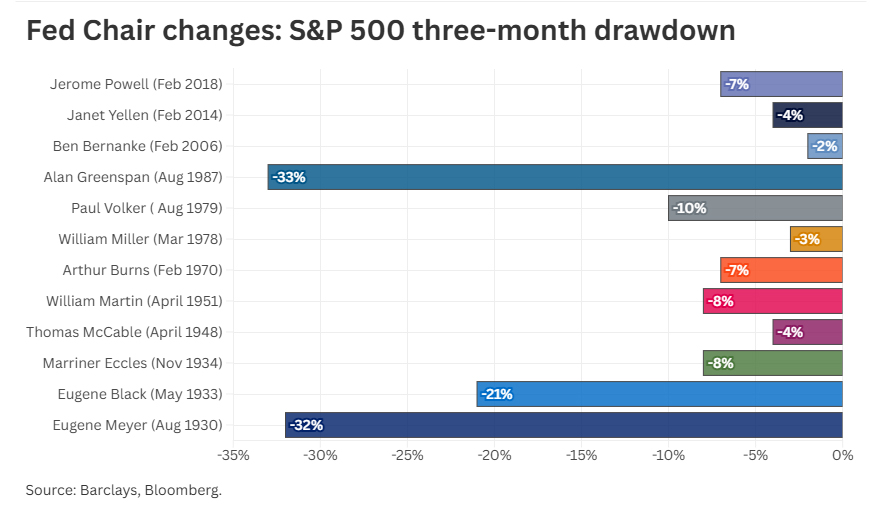
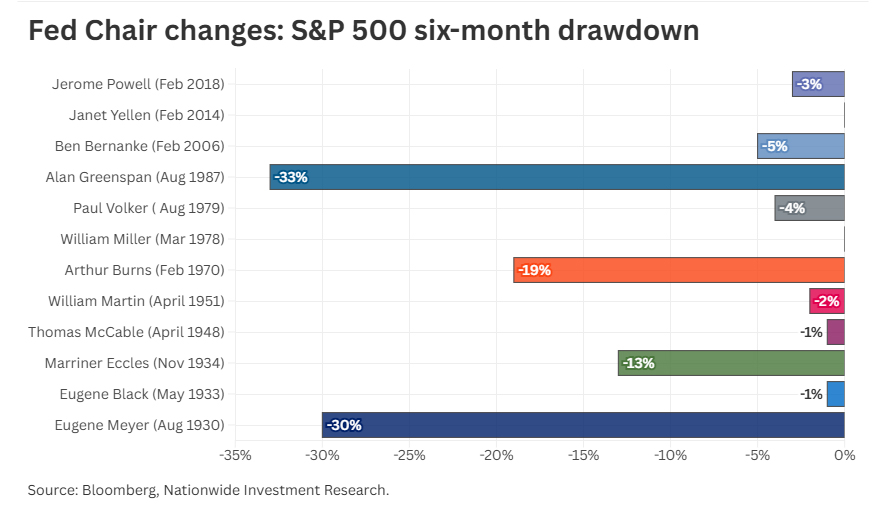
After a bit of drama, we now have a new Chair of the Federal Reserve, Kevin Warsh. If history is any guide, Chair Warsh may find the beginning of his term presents something of a challenge. Going back to 1930, incoming Fed Chairs have had S&P 500 drawdowns in the first three months of their tenure and generally through the first six months, too. These include middling corrections as well as outright bear markets, such as during the Great Depression and the early chairmanship of Alan Greenspan (late 1980s).
Some of these market downturns were presumably coincidental, though, of course, new leadership at the central bank is more likely during periods of economic upheaval. Still, the consistency of bad returns is hard to ignore. The basic fact is that the equity market dislikes uncertainty, and few things cause uncertainty like new leadership at the Fed.
Chair Warsh is likely to bring change to the Fed. He has stated he is unhappy with the steady stream of opinion and commentary put forth by the central bank’s leadership. Warsh may also introduce a new preferred gauge of inflation. For some time now, the Fed has considered core personal consumption expenditures (PCE) — which exclude food and energy — to be the best measure of inflation. Warsh is a fan of “trimmed-mean PCE,” a reading put forth by the Dallas Fed that tosses out extreme outliers (of whatever kind, not specifically food and energy). Trimmed-mean PCE is running lower than core PCE, which might permit dovishness to emerge, despite possible energy shock-related inflation concerns.
Our outlook:
A dip at the beginning of Warsh’s tenure would prove little on its own. Indeed, it could even be a further spur to lower rates if conditions permitted. The real questions will be: where does Chair Warsh want to take the Fed and how does his vision fit into (or conflict with) market conditions? Lower rates could bring a risk-on acceleration scenario and further bolster the AI boom. Higher rates increase the risk of a hard landing. Keeping rates steady could promote a growth stabilization scenario but might run the risk of prolonging inflation.
- Prolonged inflation — inflation remains sticky, energy prices stay elevated, and policy easing is delayed, supporting defensive positioning.
- Growth stabilization — inflation moderates gradually, growth remains positive, and markets broaden beyond megacaps, supporting balanced portfolios.
- Risk-on re-acceleration — geopolitical tensions ease quickly, inflation expectations fall, and markets price ongoing rate cuts, potentially supporting risk assets.
- Hard landing — growth deteriorates and financial conditions tighten, creating a risk-off environment, supporting liquidity.
Views are as of the date above and are subject to change based on market conditions and other factors. These views should not be construed as a recommendation for any specific security or sector.
Bond prices are sensitive to changes in interest rates, and a rise in interest rates can cause a decline in their prices.
High-yield, lower-rated securities generally entail greater market, credit/default and liquidity risks and may be more volatile than investment-grade securities.
Foreign investing involves special risks including currency risk, increased volatility, political risks, and differences in auditing and other financial standards.
Yield Curve: Graph showing the comparative yields of securities in a particular class according to maturity. Securities on the long end of the yield curve have longer maturities.
Past performance is no guarantee of future results.
The performance quoted is for illustrative purposes only and is not representative of any specific investment.
For additional information, including definitions of related terms and indexes, see the Financial Glossary and Benchmark Index Glossary. In addition, by accessing documents containing CUSIP information, you agree to the Terms of Use for CUSIP Information contained in the Financial Glossary.
Although the information provided has been obtained from sources which Federated Hermes believes to be reliable, it does not guarantee accuracy of such information and such information may be incomplete or condensed.
The value of equity securities will rise and fall. These fluctuations could be a sustained trend or a drastic movement.
Prices of emerging markets securities can be significantly more volatile than the prices of securities in developed countries and currency risk and political risks are accentuated in emerging markets.
There are no guarantees that dividend-paying stocks will continue to pay dividends. In addition, dividend-paying stocks may not experience the same capital appreciation potential as non-dividend-paying stocks.
Secured Overnight Financing Rate (SOFR): a broad measure of the cost of borrowing cash that is collateralized by U.S. Treasury securities. The New York Fed publishes SOFR on a daily basis.
Value stocks may lag growth stocks in performance, particularly in late stages of a market advance.
Growth stocks are typically more volatile than value stocks.
Small company stocks may be less liquid and subject to greater price volatility than large company stocks.
The value of some mortgage-backed securities may be particularly sensitive to changes in prevailing interest rates, and although the securities are generally supported by some form of government or private insurance, there is no assurance that private guarantors or insurers will meet their obligations.
Variable and floating-rate loans and securities generally are less sensitive to interest rate changes but may decline in value if their interest rates do not rise as much or as quickly as interest rates in general. Conversely, variable and floating-rate loans and securities generally will not increase in value as much as fixed-rate debt instruments if interest rates decline.
Issued and approved by Federated Advisory Services Company. Federated Hermes and its subsidiaries are not affiliated with AmeriServ.