




The oil shock’s second-order effect
What investments can help navigate inflation uncertainty?
Published: AUG 10, 2026
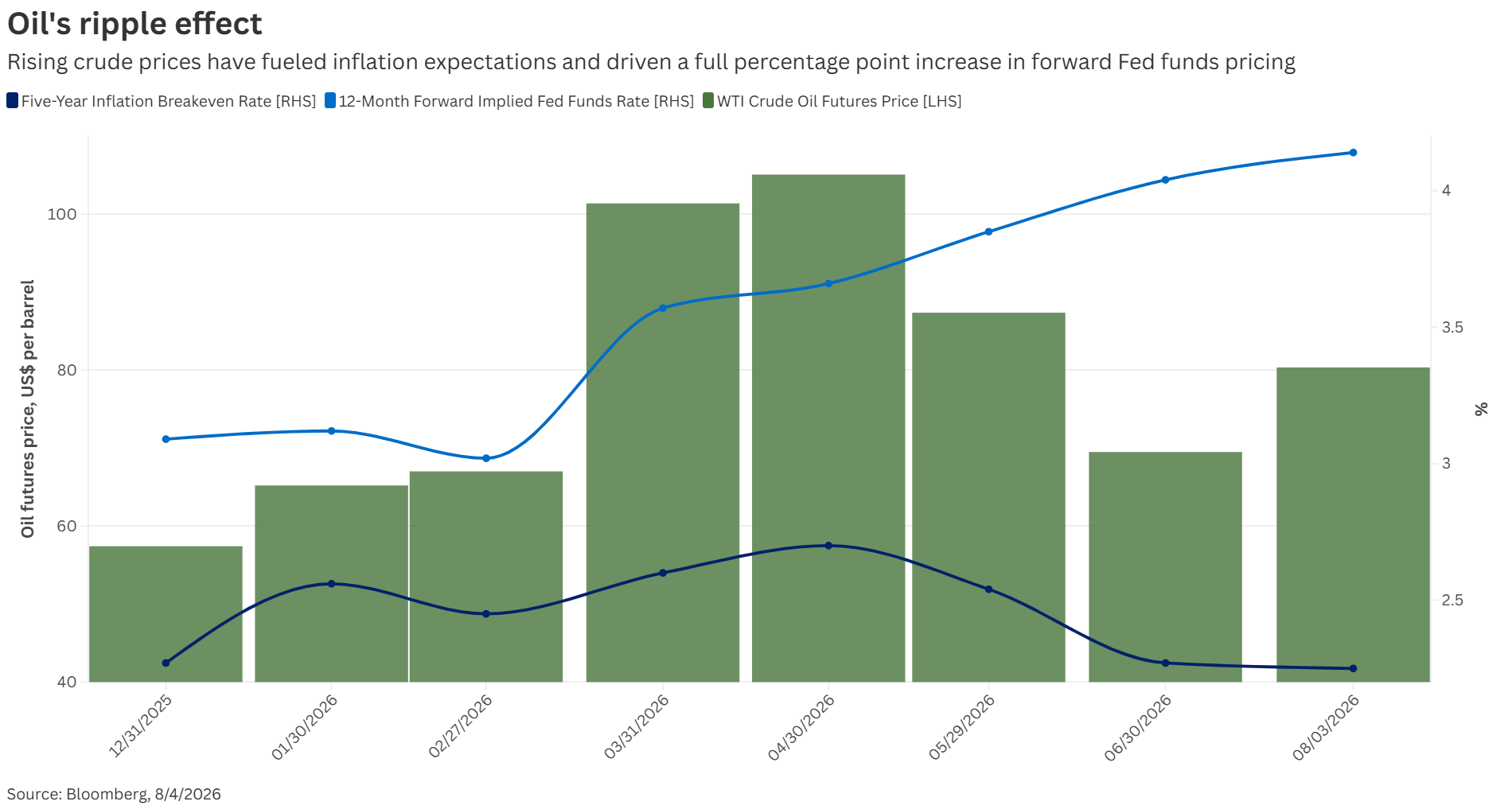
Oil prices have retreated from the spike triggered by the war in Iran, as Gulf states reroute shipments and other producers ramp up supply — though uncertainty around the Strait of Hormuz lingers. Oil’s volatility has led the market, as first one sector moves to center stage only to be given the hook soon afterwards and replaced by another. Headline inflation has seen a spike, driven up and then down by the oil price. Core inflation has shown more moderation, with the June consumer price index coming in at 2.6%. Does that round up to 3%, or does it show that 2% remains in sight?
Fixed income has been volatile too: the 10-year Treasury yield, below 4% when the war began, now sits near 4.7%. Oddly, fed funds rate expectations keep climbing even as the bond market prices in lower future inflation — a disconnect suggesting investors aren’t yet sure which story wins out. Either rate hikes succeed in keeping inflation contained, or the two forecasts aren’t as well aligned as they appear, in which case something is likely to give.
Our outlook:
Oil-driven volatility is compounding with uncertainty atop the Fed, as markets greet new Chair Warsh with the skepticism typically reserved for incoming chairs. Recent data may suggest that inflation could be headed towards the first or second scenario below. In bonds, the front end of the yield curve lets investors focus on income without over-committing to a rate-cut timeline. In equities, this year’s churn — even at all-time highs — reinforces the case for staying diversified and disciplined.
Our four economic scenarios:
- Sticky soft landing — Inflation moderates gradually, growth slows but stays positive, and the labor market cools but remains healthy. Suggested investments: Diversified equities could work well, with a tilt toward large-cap quality and international names potentially benefiting from stable global growth; small caps have less support without a stronger growth catalyst. In fixed income, short-duration strategies (roughly 1–3 years) allow a nimble stance without betting on rate-cut timing, and investment-grade credit is favored over high yield given moderate growth and contained spreads. Emerging market debt could perform reasonably well if the dollar stays range-bound.
- Inflation persistence (Stagflation lite) — Growth weakens while inflation remains sticky from energy, wages, tariffs, and geopolitics. Suggested investments: Historically large-cap, quality stocks with pricing power hold up best against margin pressure, value tends to outperform growth, and small caps look vulnerable to tightening conditions. Ultra-short and floating-rate fixed income will likely reprice if the Fed hikes, offering a potential hedge, while we prefer investment-grade credit over high yield for its stronger balance sheets. Emerging market debt is likely to lag, as sticky inflation and a firmer dollar work against it.
- Disinflationary reacceleration — Inflation cools while growth accelerates as the AI/productivity cycle broadens. Suggested investments: Small-cap and growth equities can potentially benefit most as rates ease, with international and emerging market equities also gaining from stronger global growth and a softer dollar. Short-duration fixed income can take advantage of current yields and seek to capture price upside as rates ease, and high yield credit tends to outperform investment grade as spreads tighten in a risk-on environment. Emerging market debt is well-positioned here too, potentially benefiting from both growth and currency tailwinds.
- Downside shock/Hard landing (Economic recession: tail risk) — Financial conditions tighten as the labor market deteriorates rapidly and credit stress rises. Suggested investments: Defensive, large-cap stocks help limit downside risk, while small caps and high yield credit face the most pressure. Government money market securities could help preserve capital and liquidity, with flexibility to redeploy once cuts are clearly under way. Emerging market debt is the most exposed asset class here, given the dollar strength and risk aversion that typically accompany a hard landing.
Views are as of the date above and are subject to change based on market conditions and other factors. These views should not be construed as a recommendation for any specific security or sector.
Bond prices are sensitive to changes in interest rates and a rise in interest rates can cause a decline in their prices. In addition, fixed-income investors should be aware of other risks such as credit risk, inflation risk, call risk and liquidity risk.
High-yield, lower-rated securities generally entail greater market, credit/default and liquidity risks and may be more volatile than investment-grade securities.
Foreign investing involves special risks including currency risk, increased volatility, political risks, and differences in auditing and other financial standards.
Yield Curve: Graph showing the comparative yields of securities in a particular class according to maturity. Securities on the long end of the yield curve have longer maturities.
Past performance is no guarantee of future results.
The performance quoted is for illustrative purposes only and is not representative of any specific investment.
For additional information, including definitions of related terms and indexes, see the Financial Glossary and Benchmark Index Glossary. In addition, by accessing documents containing CUSIP information, you agree to the Terms of Use for CUSIP Information contained in the Financial Glossary.
Although the information provided has been obtained from sources which Federated Hermes believes to be reliable, it does not guarantee accuracy of such information and such information may be incomplete or condensed.
The value of equity securities will rise and fall. These fluctuations could be a sustained trend or a drastic movement.
Prices of emerging markets securities can be significantly more volatile than the prices of securities in developed countries and currency risk and political risks are accentuated in emerging markets.
There are no guarantees that dividend-paying stocks will continue to pay dividends. In addition, dividend-paying stocks may not experience the same capital appreciation potential as non-dividend-paying stocks.
Secured Overnight Financing Rate (SOFR): a broad measure of the cost of borrowing cash that is collateralized by U.S. Treasury securities. The New York Fed publishes SOFR on a daily basis.
Value stocks may lag growth stocks in performance, particularly in late stages of a market advance.
Growth stocks are typically more volatile than value stocks.
Small company stocks may be less liquid and subject to greater price volatility than large company stocks.
The value of some mortgage-backed securities may be particularly sensitive to changes in prevailing interest rates, and although the securities are generally supported by some form of government or private insurance, there is no assurance that private guarantors or insurers will meet their obligations.
Variable and floating-rate loans and securities generally are less sensitive to interest rate changes but may decline in value if their interest rates do not rise as much or as quickly as interest rates in general. Conversely, variable and floating-rate loans and securities generally will not increase in value as much as fixed-rate debt instruments if interest rates decline.
Issued and approved by Federated Advisory Services Company. Federated Hermes and its subsidiaries are not affiliated with AmeriServ.