




The midterms and the market
The US equity market seems to like having midterm elections in the rearview mirror, but sometimes the market makes an exception for a hiking Fed.
Published: NOV 2, 2026
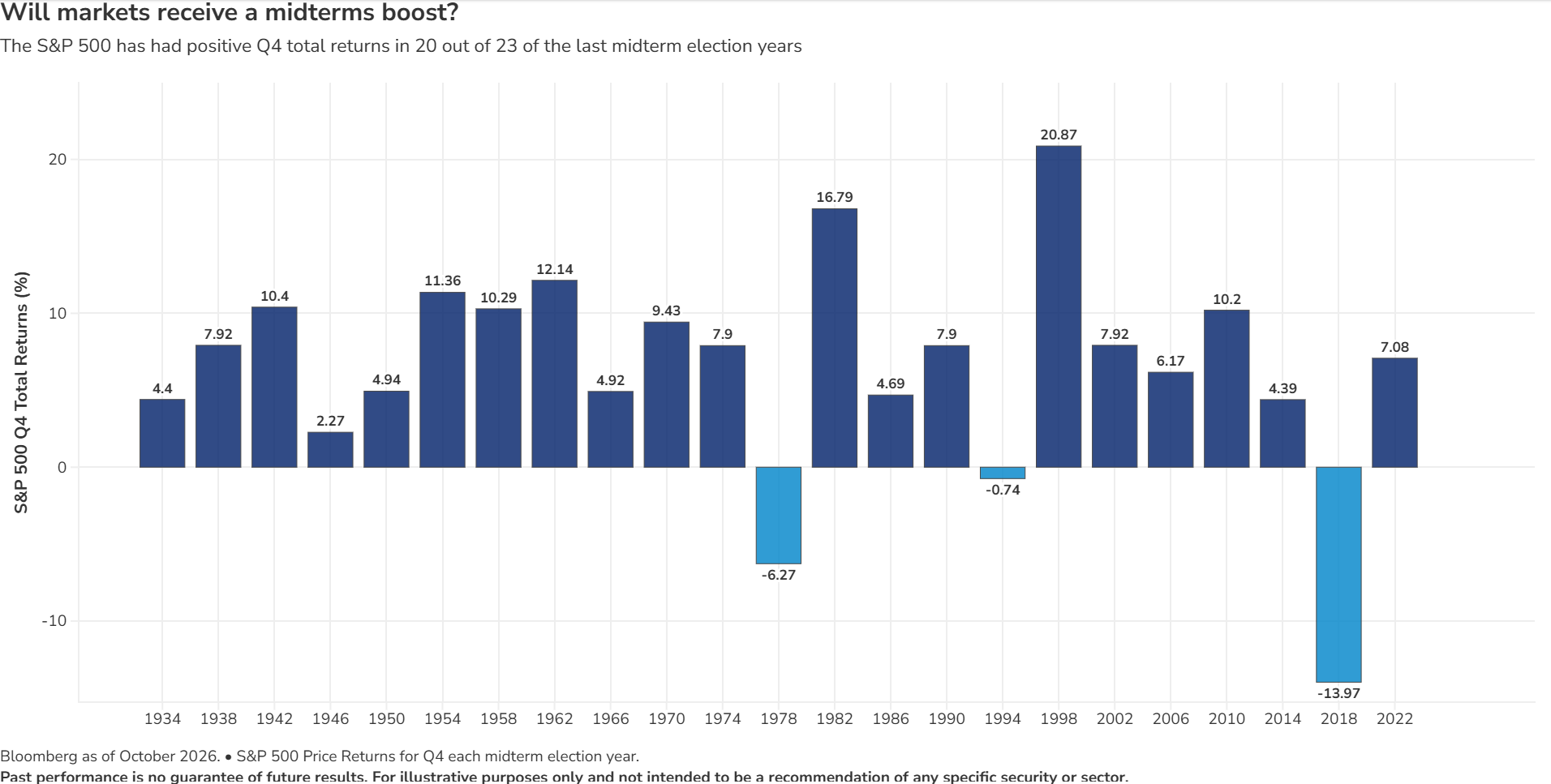
The S&P 500 has posted positive fourth-quarter returns in all but three midterm election years since 1934 (see chart below). The main hitch for those periods of negative returns was a Fed that raised rates.
Given this history, should investors now be worried? In September the central bank raised its benchmark by a quarter-point to a 3.75% to 4.00% range. All things being equal, fears of a post-midterms market slump could have merit.
Instead of joining the doomsayers, however, we would accentuate some positives. First, the central bank paused this month, meaning it may be less likely to raise rates from here and, second, a more restrictive monetary policy seems already priced in. Also, history appears to favor the optimist: equities have often rallied from the midterms into the first half of the following year, likely because the market hates uncertainty and most elections have a helpful habit of reducing that.
Yet the election can only decide so much – and even things that aren’t being voted on may make waves. The Iran war could potentially intensify, for instance. Equally, it could be that, post-election, the parties will be more receptive to a peace deal. And what of monetary policy? Chair Warsh denied that the upcoming midterms caused the Fed to pause last week, but that won’t be a consideration for the next FOMC in December. As for AI, would a Democratic Congress put the brakes on the data center buildout? That’s really more of a state and local issue, but even to the extent that it is a federal question it’s hard to see the government reversing course on a matter of such economic importance.
In general, as the chart suggests, equity markets do not play politics. It would be unwise, then, for investors to feel certain that the market shares their own perspective as to the relative merits of either of the two major parties. Perhaps that’s the main benefit of a chart like this. Some voters will be disappointed while others may be pleased. The disappointed should beware of thinking that all is forever lost; the victors should be careful not to let euphoria go to their heads. As T. S. Eliot once said, “There is no such thing as a Lost Cause because there is no such thing as a Gained Cause.”
Our outlook:
History gives some cause for optimism as to the fate of equities in the wake of midterms, but exceptions to the trend are real and painful, as in 2018. While the pattern may be mostly bullish, the main implication is simply to beware of emotion at a time like this. The forces that shape equity market performance are mostly outside of politics. The Fed’s pause at its October meeting is modestly encouraging, as it suggests the central bank does not think inflation will get out of hand. If so, a soft landing could lie ahead, potentially favoring disciplined equity strategies and, within fixed income, shorter duration.
- Sticky soft landing scenario — Inflation moderates gradually, growth slows but stays positive, and the labor market cools but remains healthy. Potential portfolio considerations: We believe diversified equities could work well, with a tilt toward large-cap quality and international names potentially benefiting from stable global growth; small caps may have less support without a stronger growth catalyst; emerging-market equities look attractive. In fixed income, short-duration strategies (roughly one- to three-years) allow a nimble stance without betting on rate-cut timing, and investment-grade credit is favored over high yield given moderate growth and contained spreads. In our view, emerging market debt can perform reasonably well if the US dollar stays range-bound.
- Inflation persistence scenario (stagflation lite) — Growth weakens while inflation remains sticky from energy costs, wages, tariffs, and geopolitics. Potential portfolio considerations: Historically, large-cap, quality stocks with pricing power tend to hold up better against margin pressure; value tends to outperform growth, and small caps may be more vulnerable to tightening conditions. Ultra-short and floating-rate fixed income reprices automatically if the Fed hikes, offering a potential hedge, while investment-grade credit may be preferable to high yield for its stronger balance sheets. Emerging market debt is likely to lag, as sticky inflation and a firmer dollar work against it.
Views are as of the date above and are subject to change based on market conditions and other factors. These views should not be construed as a recommendation for any specific security or sector.
The Institute of Supply Management (ISM) manufacturing index is a composite, forward-looking index derived from a monthly survey of U.S. businesses.
Bond prices are sensitive to changes in interest rates and a rise in interest rates can cause a decline in their prices. In addition, fixed-income investors should be aware of other risks such as credit risk, inflation risk, call risk and liquidity risk. Credit ratings are subject to change and don’t protect against market.
High-yield, lower-rated securities generally entail greater market, credit, and liquidity risk than investment-grade securities and may include higher volatility and higher risk of default.
Foreign investing involves special risks including currency risk, increased volatility, political risks, and differences in auditing and other financial standards.
Yield Curve: Graph showing the comparative yields of securities in a particular class according to maturity. Securities on the long end of the yield curve have longer maturities.
Past performance is no guarantee of future results.
The performance quoted is for illustrative purposes only and is not representative of any specific investment.
For additional information, including definitions of related terms and indexes, see the Financial Glossary and Benchmark Index Glossary. In addition, by accessing documents containing CUSIP information, you agree to the Terms of Use for CUSIP Information contained in the Financial Glossary.
Although the information provided has been obtained from sources which Federated Hermes believes to be reliable, it does not guarantee accuracy of such information and such information may be incomplete or condensed.
The value of equity securities will rise and fall. These fluctuations could be a sustained trend or a drastic movement.
Prices of emerging-markets securities can be significantly more volatile than the prices of securities in developed countries and currency risk and political risks are accentuated in emerging markets.
There are no guarantees that dividend-paying stocks will continue to pay dividends. In addition, dividend-paying stocks may not experience the same capital appreciation potential as non-dividend-paying stocks.
Secured Overnight Financing Rate (SOFR): a broad measure of the cost of borrowing cash that is collateralized by U.S. Treasury securities. The New York Fed publishes SOFR on a daily basis.
Value stocks may lag growth stocks in performance, particularly in late stages of a market advance.
Growth stocks are typically more volatile than value stocks.
Small company stocks may be less liquid and subject to greater price volatility than large company stocks.
The value of some mortgage-backed securities may be particularly sensitive to changes in prevailing interest rates, and although the securities are generally supported by some form of government or private insurance, there is no assurance that private guarantors or insurers will meet their obligations.
Variable and floating rate loans and securities generally are less sensitive to interest rate changes but may decline in value if their interest rates do not rise as much or as quickly as interest rates in general. Conversely, variable and floating rate loans and securities generally will not increase in value as much as fixed rate debt instruments if interest rates decline.
The value of investments and income from them may go down as well as up, and you may not get back the original amount invested. Past performance is not a reliable indicator of future results.
This is a marketing communication. The views and opinions contained herein are as of the date indicated above, are those of author(s) noted above, and may not necessarily represent views expressed or reflected in other communications, strategies or products. These views are as of the date indicated above and are subject to change based on market conditions and other factors. The information herein is believed to be reliable, but Federated Hermes and its subsidiaries do not warrant its completeness or accuracy. No responsibility can be accepted for errors of fact or opinion. This material is not intended to provide and should not be relied on for accounting, legal or tax advice, or investment recommendations. This document has no regard to the specific investment objectives, financial situation or particular needs of any specific recipient.
This document is published solely for informational purposes and is not to be construed as a solicitation or an offer to buy or sell any securities, related financial instruments or advisory services. Figures, unless otherwise indicated, are sourced from Federated Hermes. Federated Hermes has attempted to ensure the accuracy of the data it is reporting, however, it makes no representations or warranties, expressed or implied, as to the accuracy or completeness of the information reported. The data contained in this document is for informational purposes only, and should not be relied upon to make investment decisions.
Federated Hermes shall not be liable for any loss or damage resulting from the use of any information contained on this document. This document is not investment research and is available to any investment firm wishing to receive it. The distribution of the information contained in this document in certain jurisdictions may be restricted and, accordingly, persons into whose possession this document comes are required to make themselves aware of and to observe such restrictions.
United States: This information is being provided by Federated Hermes, Inc., Federated Advisory Services Company, Federated Equity Management Company of Pennsylvania, and Federated Investment Management Company, at address 1001 Liberty Avenue, Pittsburgh, PA 15222-3779, Federated Global Investment Management Corp. at address 101 Park Avenue, Suite 4100, New York, New York 10178-0002, and MDT Advisers at address 125 High Street Oliver Street Tower, 21st Floor Boston, Massachusetts 02110.
Issued and approved by Federated Advisory Services Company. Federated Hermes and its subsidiaries are not affiliated with AmeriServ.