




Midway through this year
What worked, what didn’t in the first half of 2026.
Published: JULY 6, 2026
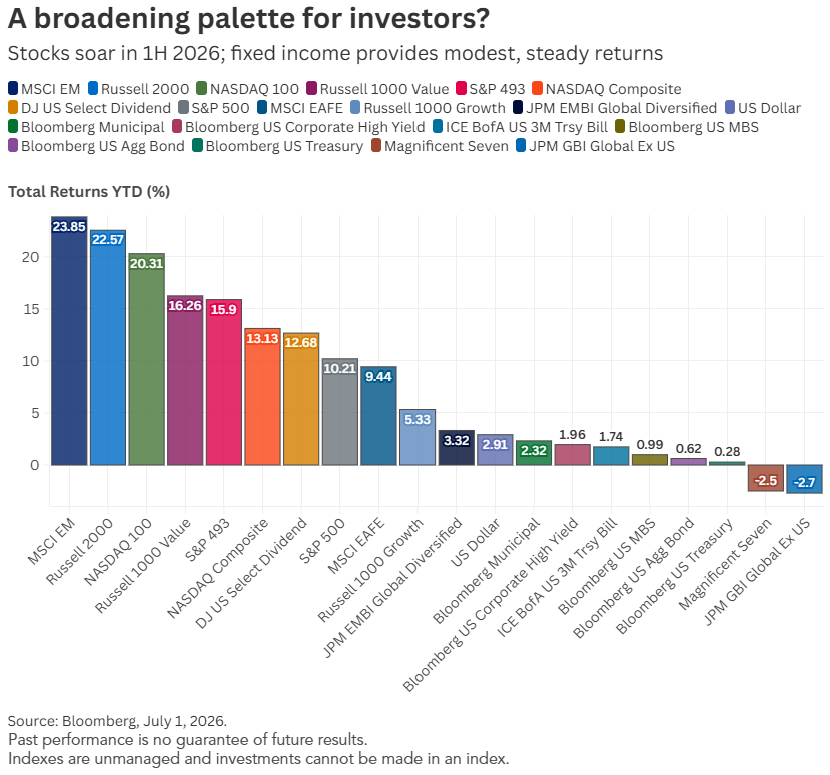
And just like that the new year that was is now half over. Emerging markets were the global equity leaders of the first half, just as they had been in 2025. Unlike last year, however, equities in developed markets failed, albeit narrowly, to outperform those in the US.
Small caps in the US shone brightly as the market continued to broaden beyond its Magnificent Seven (Mag 7) fixation of yore. Indeed, for the first six months of 2026, the Mag 7 as a group are negative.
Fixed income mostly notched gains year-to-date but those were constrained by the effects of resurgent inflation, which caused yields to rise, particularly at the long end where returns on longer-dated securities lagged Treasury bills.
Earlier in the year, expectations were for the Fed to resume cutting rates, a view that’s now been flipped due to the inflationary effects of the war in Iran.
Worthy of note, however, is how far oil prices have retreated thanks to the tentative cease fire. If that holds and if oil stays within reach of prewar levels, we could see inflation resume its downward course, opening the door, once more, to a dovish course for the Fed.
It won’t be long before we’re wondering what happened to summer, for its “lease hath all too short a date” as Shakespeare tells us. Enjoy it while you can!
Indexes are unmanaged and investments cannot be made in an index.
Our outlook:
The big variables facing markets in the second half are inflation, the Iran war and the US midterms. The first two, as noted, are very much interwoven: if the war can be resolved, inflation might well stage a retreat. And perhaps the midterms are not so much an unknown as something to get past, at least for the equity markets. Of the 16 quarters of the presidential election cycle, only the second and third quarters of the midterm year are, on average, negative for stocks.
As a general matter, a prolonged inflationary scenario would be negative for bonds but could be positive for stocks, whereas the reverse would likely be true for a hard landing. Growth stabilization could benefit both stocks and bonds, while a risk-on reacceleration would likely be particularly beneficial for growth and AI stocks.
Our four economic scenarios:
- Prolonged inflation — inflation remains sticky, energy prices stay elevated, and policy easing is delayed, supporting defensive positioning.
- Growth stabilization — inflation moderates gradually, growth remains positive, and markets broaden beyond megacaps, supporting balanced portfolios.
- Risk-on re-acceleration — geopolitical tensions ease quickly, inflation expectations fall, and markets price ongoing rate cuts, potentially supporting risk assets.
- Hard landing — growth deteriorates and financial conditions tighten, creating a risk-off environment, supporting liquidity.
Views are as of the date above and are subject to change based on market conditions and other factors. These views should not be construed as a recommendation for any specific security or sector.
Bond prices are sensitive to changes in interest rates and a rise in interest rates can cause a decline in their prices. In addition, fixed-income investors should be aware of other risks such as credit risk, inflation risk, call risk and liquidity risk.
High-yield, lower-rated securities generally entail greater market, credit/default and liquidity risks and may be more volatile than investment-grade securities.
Foreign investing involves special risks including currency risk, increased volatility, political risks, and differences in auditing and other financial standards.
Yield Curve: Graph showing the comparative yields of securities in a particular class according to maturity. Securities on the long end of the yield curve have longer maturities.
Past performance is no guarantee of future results.
The performance quoted is for illustrative purposes only and is not representative of any specific investment.
For additional information, including definitions of related terms and indexes, see the Financial Glossary and Benchmark Index Glossary. In addition, by accessing documents containing CUSIP information, you agree to the Terms of Use for CUSIP Information contained in the Financial Glossary.
Although the information provided has been obtained from sources which Federated Hermes believes to be reliable, it does not guarantee accuracy of such information and such information may be incomplete or condensed.
The value of equity securities will rise and fall. These fluctuations could be a sustained trend or a drastic movement.
Prices of emerging markets securities can be significantly more volatile than the prices of securities in developed countries and currency risk and political risks are accentuated in emerging markets.
There are no guarantees that dividend-paying stocks will continue to pay dividends. In addition, dividend-paying stocks may not experience the same capital appreciation potential as non-dividend-paying stocks.
Secured Overnight Financing Rate (SOFR): a broad measure of the cost of borrowing cash that is collateralized by U.S. Treasury securities. The New York Fed publishes SOFR on a daily basis.
Value stocks may lag growth stocks in performance, particularly in late stages of a market advance.
Growth stocks are typically more volatile than value stocks.
Small company stocks may be less liquid and subject to greater price volatility than large company stocks.
The value of some mortgage-backed securities may be particularly sensitive to changes in prevailing interest rates, and although the securities are generally supported by some form of government or private insurance, there is no assurance that private guarantors or insurers will meet their obligations.
Variable and floating-rate loans and securities generally are less sensitive to interest rate changes but may decline in value if their interest rates do not rise as much or as quickly as interest rates in general. Conversely, variable and floating-rate loans and securities generally will not increase in value as much as fixed-rate debt instruments if interest rates decline.
Issued and approved by Federated Advisory Services Company. Federated Hermes and its subsidiaries are not affiliated with AmeriServ.