




It may pay to stay put
Higher long-term yields look less like a warning sign and more like a return to normal — and the Fed's own signals are the reason to stay at the front end.
Published: AUG 3, 2026
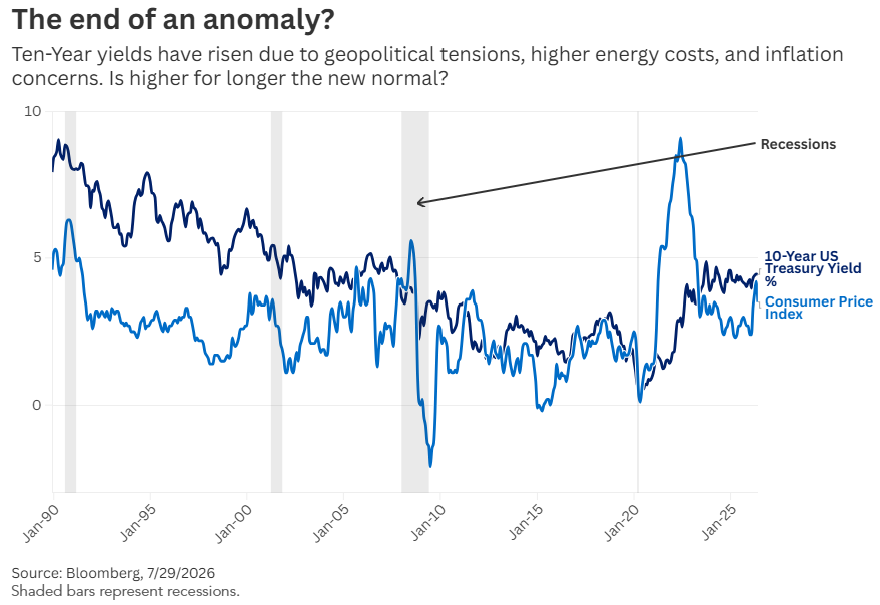
Long-term Treasury yields have moved sharply higher. After dipping below 4% just before fighting with Iran resumed in late February, the 10-year has climbed roughly 70 basis points to 4.65%; the 30-year has cleared 5%. The proximate cause is a revived inflation scare, as renewed conflict pushes oil prices higher and stirs fears that inflation proves stickier than investors expected at the start of the year.
That is a sharp reversal. Investors began 2026 pricing rate cuts; markets have since assigned as much as a 70% probability to a hike at the Fed's September meeting instead.
Step back, though, and today's yields look less like an anomaly than a return to normal. Positive real yields — Treasury yields above inflation — were the rule for decades; only after the Global Financial Crisis, and again during the post-Covid inflation spike, did real yields frequently turn negative. That stretch also reshaped how investors saw bonds, prizing them for capital appreciation in a downturn rather than for the coupon itself. A yield near 5%, with inflation running comfortably below it, is unusual only by the standards of 2008–2020.
Our outlook:
Yields that rise too far bring their own problems — falling bond prices, elevated mortgage rates, expensive-looking equities. Yields that fall too far bring others — yield curve inversion, financial repression. That two-sided risk is exactly why duration is a bet right now, not a certainty, and why active management matters: it lets portfolio managers move opportunistically as the picture clarifies.
Until it does, investors do not need to guess which way the Fed breaks. Money market, short duration, and adjustable-rate strategies can provide income at the front end of the yield curve without taking on the higher price risk a resolution either way would bring to longer bonds.
Our four economic scenarios:
- Sticky soft landing — Inflation moderates gradually, growth slows but remains positive and the labor market cools but remains healthy. Suggested investments: ultra-short strategies track a slow-moving Fed without an early bet on the timing of cuts.
- Inflation persistence (Stagflation lite) — Growth weakens while inflation remains sticky from energy, wages, tariffs, and geopolitics. Suggested investments: adjustable-rate bonds reprice higher automatically if the Fed hikes — a potential hedge against this scenario.
- Disinflationary reacceleration — Inflation cools while growth accelerates; AI/productivity cycle broadens. Suggested investments: short-duration bond strategies can take advantage of current yields and seek to capture price upside as rates ease.
- Downside shock/Hard landing (Economic recession: tail risk) — Financial conditions tighten as the labor market deteriorates rapidly and credit stress rises. Suggested investments: government/prime money market investments are designed to preserve capital and liquidity, with flexibility to redeploy once cuts are clearly under way.
Views are as of the date above and are subject to change based on market conditions and other factors. These views should not be construed as a recommendation for any specific security or sector.
Bond prices are sensitive to changes in interest rates and a rise in interest rates can cause a decline in their prices. In addition, fixed-income investors should be aware of other risks such as credit risk, inflation risk, call risk and liquidity risk.
High-yield, lower-rated securities generally entail greater market, credit/default and liquidity risks and may be more volatile than investment-grade securities.
Foreign investing involves special risks including currency risk, increased volatility, political risks, and differences in auditing and other financial standards.
Yield Curve: Graph showing the comparative yields of securities in a particular class according to maturity. Securities on the long end of the yield curve have longer maturities.
Past performance is no guarantee of future results.
The performance quoted is for illustrative purposes only and is not representative of any specific investment.
For additional information, including definitions of related terms and indexes, see the Financial Glossary and Benchmark Index Glossary. In addition, by accessing documents containing CUSIP information, you agree to the Terms of Use for CUSIP Information contained in the Financial Glossary.
Although the information provided has been obtained from sources which Federated Hermes believes to be reliable, it does not guarantee accuracy of such information and such information may be incomplete or condensed.
The value of equity securities will rise and fall. These fluctuations could be a sustained trend or a drastic movement.
Prices of emerging markets securities can be significantly more volatile than the prices of securities in developed countries and currency risk and political risks are accentuated in emerging markets.
There are no guarantees that dividend-paying stocks will continue to pay dividends. In addition, dividend-paying stocks may not experience the same capital appreciation potential as non-dividend-paying stocks.
Secured Overnight Financing Rate (SOFR): a broad measure of the cost of borrowing cash that is collateralized by U.S. Treasury securities. The New York Fed publishes SOFR on a daily basis.
Value stocks may lag growth stocks in performance, particularly in late stages of a market advance.
Growth stocks are typically more volatile than value stocks.
Small company stocks may be less liquid and subject to greater price volatility than large company stocks.
The value of some mortgage-backed securities may be particularly sensitive to changes in prevailing interest rates, and although the securities are generally supported by some form of government or private insurance, there is no assurance that private guarantors or insurers will meet their obligations.
Variable and floating-rate loans and securities generally are less sensitive to interest rate changes but may decline in value if their interest rates do not rise as much or as quickly as interest rates in general. Conversely, variable and floating-rate loans and securities generally will not increase in value as much as fixed-rate debt instruments if interest rates decline.
Issued and approved by Federated Advisory Services Company. Federated Hermes and its subsidiaries are not affiliated with AmeriServ.