




Invest for uncertainty
Uncertainty is a constant – it’s the investor response that matters.
Published: AUG 31, 2026
For most investors, uncertainty is a given: it’s rare to find a day where the knowns outweigh the unknowns. Recent events are no different.
Take the Treasury market, for instance. Here, Treasury Secretary Bessent aimed to calm the waters recently with his surprise “Treasury Twist,” buying up 30-year bonds in an effort to bring yields down and counter the bond vigilantes. Will those efforts stick? Right now it’s hard to tell, though market data suggests not. Early in his career, Secretary Bessent helped George Soros pull off a big short against the British pound; he must be hoping that what he learned then will serve him well now.
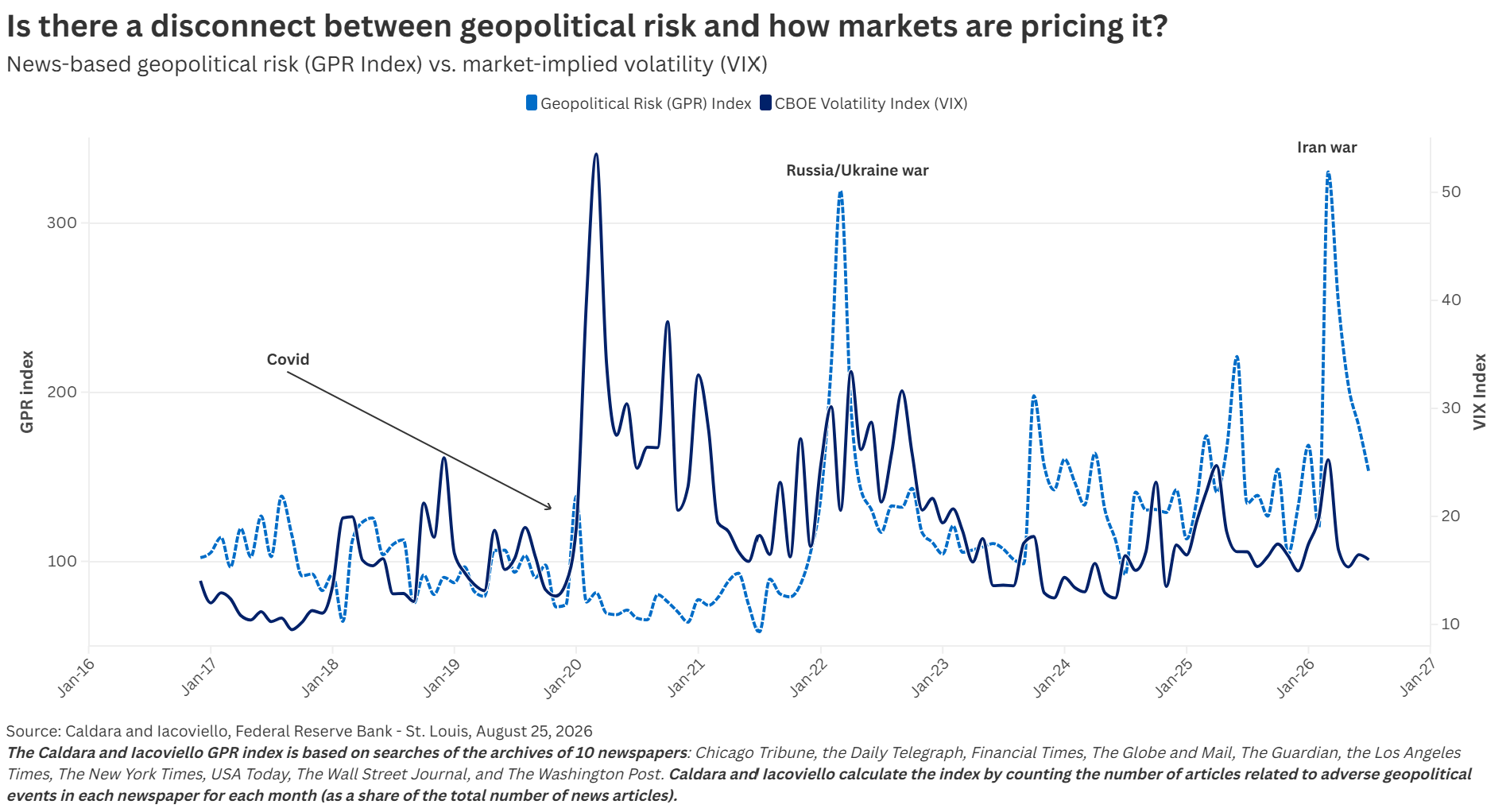
The Iran war and the US midterm elections are two other big sources of uncertainty. For the former, it could be, as some have suggested, that Iran will be more willing to make a deal after the midterms.
As for the midterms themselves, there is a pattern that at least could serve as a template, if it continues to hold. It’s that the stock market often slumps into the midterms only to snap back smartly afterwards, rallying into the middle of the following year. Taking the 16 calendar quarters of the presidential election cycle, only Q2 and Q3 of the midterm year (i.e., right now) are on average negative for stocks. Yet, the second quarter this year was positive for US equities – so perhaps the pattern won’t hold this year after all.
That’s the thing about uncertainty. From an investment point of view, uncertainty is finite, not infinite. Some (maybe even a lot) of the current unknowns may be settled with the midterms. But nothing’s a given.
In the meantime, whether from a dividend or a coupon, there’s a lot to be said for getting paid now: a bird in the hand. Geopolitical risk may continue to be elevated – and that may even be a boon for investors. Equities, for example, tend to climb a wall of worry. Sticking to a prudent approach maximizes the opportunity for satisfactory outcomes.
Our outlook:
The markets currently are not just being driven by inflation and the Fed. Heavy supply has been complicating bond yields, while anxiety about AI (even amid strong earnings) worries equity investors. Still, if bond yields are not brought under control, that has tended to indicate that growth will be slower and inflation will be higher – a stagflation-lite scenario.
Within fixed income, investing in shorter duration securities can potentially help asset owners avoid being whipsawed by volatility in the longer end of the yield curve. In equities, diversified portfolios and disciplined processes could provide stability even if volatility increases.
- Sticky soft landing — Inflation moderates gradually, growth slows but stays positive, and the labor market cools but remains healthy. Potential portfolio considerations: Diversified equities are attractive, with a tilt toward large-cap quality and international names may benefit from stable global growth; small caps have less support without a stronger growth catalyst. In fixed income, short-duration strategies (roughly one to three years) allow a nimble stance without betting on rate-cut timing, and investment-grade credit is appealing compared to high yield given moderate growth and contained spreads. Emerging market debt has the potential to perform reasonably well if the dollar stays range bound.
- Inflation persistence (stagflation lite) — Growth weakens while inflation remains sticky from energy, wages, tariffs, and geopolitics. Potential portfolio considerations: Large-cap, quality stocks with pricing power hold up best against margin pressure; value tends to outperform growth, and small caps look vulnerable to tightening conditions. Ultra-short and floating-rate fixed income will likely reprice if the Fed hikes, offering a hedge, while we prefer investment-grade credit over high yield for its stronger balance sheets. Emerging market debt is likely to lag, as sticky inflation and a firmer dollar work against it.
Views are as of the date above and are subject to change based on market conditions and other factors. These views should not be construed as a recommendation for any specific security or sector.
Bond prices are sensitive to changes in interest rates and a rise in interest rates can cause a decline in their prices. In addition, fixed-income investors should be aware of other risks such as credit risk, inflation risk, call risk and liquidity risk.
High-yield, lower-rated securities generally entail greater market, credit, and liquidity risk than investment-grade securities and may include higher volatility and higher risk of default.
Foreign investing involves special risks including currency risk, increased volatility, political risks, and differences in auditing and other financial standards.
Yield Curve: Graph showing the comparative yields of securities in a particular class according to maturity. Securities on the long end of the yield curve have longer maturities.
Past performance is no guarantee of future results.
The performance quoted is for illustrative purposes only and is not representative of any specific investment.
For additional information, including definitions of related terms and indexes, see the Financial Glossary and Benchmark Index Glossary. In addition, by accessing documents containing CUSIP information, you agree to the Terms of Use for CUSIP Information contained in the Financial Glossary.
The value of equity securities will rise and fall. These fluctuations could be a sustained trend or a drastic movement.
Prices of emerging-markets securities can be significantly more volatile than the prices of securities in developed countries and currency risk and political risks are accentuated in emerging markets.
There are no guarantees that dividend-paying stocks will continue to pay dividends. In addition, dividend-paying stocks may not experience the same capital appreciation potential as non-dividend-paying stocks.
Secured Overnight Financing Rate (SOFR): a broad measure of the cost of borrowing cash that is collateralized by U.S. Treasury securities. The New York Fed publishes SOFR on a daily basis.
Value stocks may lag growth stocks in performance, particularly in late stages of a market advance.
The fund may invest in small capitalization (or "small-cap") companies. Small-cap companies may have less liquid stock, a more volatile share price, unproven track records, a limited product or service base and limited access to capital. The above factors could make small-cap companies more likely to fail than larger companies and increase the volatility of the fund's portfolio, performance and share price. Suitable securities of small-cap companies also can have limited availability and cause capacity constraints on investment strategies for funds that invest in them.
Small company stocks may be less liquid and subject to greater price volatility than large company stocks.
The value of some mortgage-backed securities may be particularly sensitive to changes in prevailing interest rates, and although the securities are generally supported by some form of government or private insurance, there is no assurance that private guarantors or insurers will meet their obligations.
Variable and floating rate loans and securities generally are less sensitive to interest rate changes but may decline in value if their interest rates do not rise as much or as quickly as interest rates in general. Conversely, variable and floating rate loans and securities generally will not increase in value as much as fixed rate debt instruments if interest rates decline.
Issued and approved by Federated Advisory Services Company. Federated Hermes and its subsidiaries are not affiliated with AmeriServ.