




Inflation drifts lower but remains too high
The Fed is likely to station itself on the sidelines for now.
Published: AUG 24, 2026
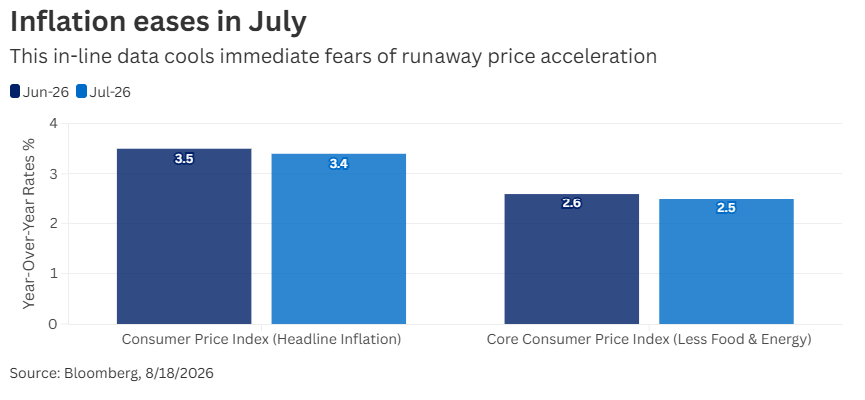
How might Americans be thinking about their investments at this moment of economic uncertainty? Inflation appears to be headed in the right direction, though that could easily change. The Federal Reserve (Fed) doesn’t yet have a clear signal on whether to raise rates or cut them or stand pat. The Iran war could cause that to change, if prices on oil resume their march higher.
The Fed’s next meeting is in September, and it isn’t particularly likely that the central bank would hike into the teeth of the elections. So it might be that the Fed has several months of watchful waiting to see if inflation’s path will better declare itself. The annual summer retreat at Jackson Hole will at least give Chair Warsh the opportunity to offer some color on where he thinks the central bank should be heading.
In the meantime, long-term bonds have seen their yields spike higher lately, causing the Treasury to increase buybacks of longer-dated bonds. As for equities, index returns and recent earnings seasons suggest the US economy is in at least reasonable health.
Given this, it seems likely that equity markets could stomach at least a hike or two from here (albeit reluctantly). After all, they’re rallying right now even in the midst of forecasts for rate hikes this year. If, on the other hand, rates are held steady or even cut, then the outlook for equities would be more favorable still. The weak July jobs report together with restrained inflation readings have made many onlookers marginally less hawkish. Soon enough – though probably not very soon – we will learn where the Fed itself stands.
Our outlook:
Yields on shorter-duration bonds are fairly attractive, but they have a potential advantage in more than one scenario: they should escape some of the volatility to which uncertainty exposes longer-duration bonds. Historically, equities have tended to perform well in sticky soft-landing scenarios and held up reasonably well amid persistent inflation.
- Sticky soft landing — Inflation moderates gradually, growth slows but stays positive, and the labor market cools but remains healthy. Potential portfolio considerations: Diversified equities may be well- positioned in this scenario, with a tilt toward large-cap quality and international names potentially benefiting from stable global growth; small caps may have less support without a stronger growth catalyst. In fixed income, short-duration strategies (roughly one to three years) may allow a more nimble stance without betting on rate-cut timing, and investment-grade credit is favored over high yield given the expectation for moderate growth and contained spreads. Emerging market debt could perform reasonably well if the dollar stays range bound.
- Inflation persistence (stagflation lite) — Growth weakens while inflation remains sticky from energy, wages, tariffs, and geopolitics. Potential portfolio considerations: Large-cap, quality stocks with pricing power may hold up better against margin pressure, value could outperform growth, and small caps may be more vulnerable to tightening conditions. Ultra-short and floating-rate fixed income should reprice more quickly if the Fed hikes, which may offer a partial hedge, while investment-grade credit may be preferred over high yield for its stronger balance sheets. Emerging market debt is likely to lag, as sticky inflation and a firmer dollar could work against it.
Views are as of the date above and are subject to change based on market conditions and other factors. These views should not be construed as a recommendation for any specific security or sector.
Bond prices are sensitive to changes in interest rates and a rise in interest rates can cause a decline in their prices. In addition, fixed-income investors should be aware of other risks such as credit risk, inflation risk, call risk and liquidity risk.
High-yield, lower-rated securities generally entail greater market, credit, and liquidity risk than investment-grade securities and may include higher volatility and higher risk of default.
Foreign investing involves special risks including currency risk, increased volatility, political risks, and differences in auditing and other financial standards.
Yield Curve: Graph showing the comparative yields of securities in a particular class according to maturity. Securities on the long end of the yield curve have longer maturities.
Past performance is no guarantee of future results.
The performance quoted is for illustrative purposes only and is not representative of any specific investment.
For additional information, including definitions of related terms and indexes, see the Financial Glossary and Benchmark Index Glossary. In addition, by accessing documents containing CUSIP information, you agree to the Terms of Use for CUSIP Information contained in the Financial Glossary.
Although the information provided has been obtained from sources which Federated Hermes believes to be reliable, it does not guarantee accuracy of such information and such information may be incomplete or condensed.
The value of equity securities will rise and fall. These fluctuations could be a sustained trend or a drastic movement.
Prices of emerging-markets securities can be significantly more volatile than the prices of securities in developed countries and currency risk and political risks are accentuated in emerging markets.
There are no guarantees that dividend-paying stocks will continue to pay dividends. In addition, dividend-paying stocks may not experience the same capital appreciation potential as non-dividend-paying stocks.
Secured Overnight Financing Rate (SOFR): a broad measure of the cost of borrowing cash that is collateralized by U.S. Treasury securities. The New York Fed publishes SOFR on a daily basis.
Value stocks may lag growth stocks in performance, particularly in late stages of a market advance.
Growth stocks are typically more volatile than value stocks.
The fund may invest in small capitalization (or "small-cap") companies. Small-cap companies may have less liquid stock, a more volatile share price, unproven track records, a limited product or service base and limited access to capital. The above factors could make small-cap companies more likely to fail than larger companies and increase the volatility of the fund's portfolio, performance and share price. Suitable securities of small-cap companies also can have limited availability and cause capacity constraints on investment strategies for funds that invest in them.
Small company stocks may be less liquid and subject to greater price volatility than large company stocks.
The value of some mortgage-backed securities may be particularly sensitive to changes in prevailing interest rates, and although the securities are generally supported by some form of government or private insurance, there is no assurance that private guarantors or insurers will meet their obligations.
Variable and floating rate loans and securities generally are less sensitive to interest rate changes but may decline in value if their interest rates do not rise as much or as quickly as interest rates in general. Conversely, variable and floating rate loans and securities generally will not increase in value as much as fixed rate debt instruments if interest rates decline.
Issued and approved by Federated Advisory Services Company. Federated Hermes and its subsidiaries are not affiliated with AmeriServ.